


Dubai World Cup 2027 Returns to Meydan With a $12 Million Main Race
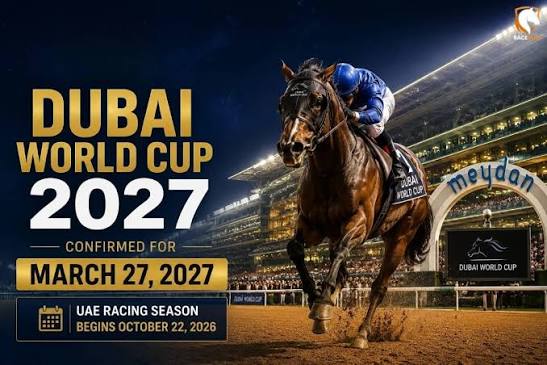
Dubai’s horse-racing season will reach its biggest stage on 27 March 2027 when the Dubai World Cup returns to Meydan Racecourse.
The headline race will again offer US$12 million in prize money, placing it among the richest and most prestigious Thoroughbred contests in international racing.
The wider Dubai World Cup meeting is even larger.
Meydan’s championship programme features nine races worth a combined US$30.5 million, attracting horses, jockeys, trainers and owners from leading racing jurisdictions around the world.
For Dubai, the World Cup is not simply the final race meeting of the season.
It is one of the city’s longest-established international sporting showcases and the event toward which the entire Dubai Racing Carnival builds from November onwards.
The Entire Season Leads to March 27
Dubai’s 2026–27 racing programme begins months before World Cup night.
Meydan hosts 17 meetings across the season, including major Carnival fixtures and Emirates Super Saturday before the final championship evening.
This structure gives horses several opportunities to compete under Dubai conditions.
Trainers can identify suitable races.
Jockeys learn how individual horses respond to Meydan.
International challengers can travel to the UAE before the biggest night.
By the time 27 March arrives, months of racing have already created storylines.
Some horses will have built strong local form.
Others may arrive directly from major international campaigns.
The question becomes whether proven Dubai form or international reputation matters more when the gates open.
The $12 Million Main Race Changes Careers
Prize money at this level creates enormous stakes.
The Dubai World Cup is worth $12 million.
Winning affects more than one night.
A victory can dramatically increase a horse’s value, particularly for future breeding.
Jockeys add one of racing’s most recognisable international trophies to their careers.
Trainers gain global prestige.
Owners receive both financial reward and sporting recognition.
Even horses finishing behind the winner can earn substantial prize money.
This creates a field where every position matters.
Nine Races Create a Full Championship Programme
World Cup night is not built around one race followed by minor supporting contests.
The complete card features nine significant races across different surfaces, distances and horse categories.
This includes Thoroughbred and Purebred Arabian competition.
That variety gives the evening international depth.
Different horses excel under different conditions.
A sprinter cannot simply be compared with a long-distance turf horse.
Dirt specialists face different demands from turf competitors.
Each race rewards a different type of athlete.
Meydan Is Built for a Global Event
Meydan Racecourse is one of the most distinctive racing venues in the world.
The grandstand stretches approximately 1.5 kilometres and can accommodate enormous crowds across hospitality, dining and general spectator areas.
Its scale becomes especially important on World Cup night.
Thousands of people arrive not only for racing but for the complete social occasion.
International visitors mix with UAE residents.
Owners and racing professionals arrive from multiple continents.
Fashion, hospitality and sport exist in the same environment.
The venue was designed for exactly this type of event.
Dirt Racing Rewards Position and Pace
The Dubai World Cup itself is contested on dirt.
Dirt racing creates tactical challenges that can differ considerably from turf competition.
Position becomes extremely important.
Horses travelling behind rivals may receive kickback from the surface.
Jockeys need to decide whether to seek an early prominent position or conserve energy before challenging later.
Going too quickly early can leave a horse vulnerable in the finishing stages.
Waiting too long can create traffic problems.
A jockey therefore needs to understand both the horse and how the race is developing.
The Start Can Shape the Entire Race
Draw position and the opening seconds can strongly influence a dirt race.
A horse that breaks slowly may immediately lose the intended tactical position.
Another may use too much energy trying to reach the front.
Several horses competing for the same early position can create a very fast opening pace.
That may help a runner waiting behind them.
This is why experienced racing fans watch much more than the finishing straight.
The race begins tactically the moment the gates open.
Jockey Decisions Happen at Full Speed
The horse provides the athletic power, but the jockey makes decisions constantly.
Where is the pace?
Is there room to move?
Should the horse challenge now?
Is another runner beginning to weaken?
Can energy be saved for another 200 metres?
These decisions happen while travelling at high speed among other horses.
There is no pause button.
A decision made several seconds too late can eliminate an opportunity.
This is one reason the world’s leading jockeys are so valuable.
International Participation Defines the Dubai World Cup
The Dubai Racing Carnival has become increasingly international.
During the 2025–26 season, Meydan welcomed dozens of international trainers and more than 130 overseas-trained horses.
Winners represented multiple racing nations.
The World Cup is the natural conclusion of that international programme.
Horses can arrive from Europe, Asia, North America and other major racing regions.
Different racing systems meet on one evening.
That is part of what makes the event globally significant.
The Road to Dubai Extends Beyond the UAE
Dubai Racing Club has continued developing international links to strengthen the pathway toward World Cup night.
Major races elsewhere can influence which horses ultimately travel to Meydan.
This gives Dubai World Cup season a global dimension before horses even reach the UAE.
Fans following racing internationally begin considering possible World Cup contenders months in advance.
Who has the right running style?
Which dirt horses are improving?
Which turf stars could target one of the supporting races?
Speculation becomes part of the season.
The 2026 Winner Sets the Benchmark
Every new edition begins with comparison to what happened previously.
The defending race history creates expectations for 2027.
Will an established star return?
Will a new international challenger emerge?
Could a Dubai Carnival runner develop into a genuine World Cup contender?
Horse racing changes quickly because form, fitness and campaign plans evolve continuously.
A horse that looks ordinary in autumn can improve dramatically by spring.
That uncertainty keeps the buildup interesting.
World Cup Night Is Also a Major Social Event
The racing remains central, but the Dubai World Cup has long been one of the city’s major lifestyle occasions.
Hospitality packages, dining and fashion form part of the experience.
Many spectators attend every year even without following horse racing throughout the season.
This broader audience helps distinguish the event from ordinary race meetings.
The sporting contest attracts racing professionals.
The social occasion attracts a much wider crowd.
Meydan brings both groups together.
First-Time Spectators Can Enjoy Racing Without Knowing Everything
Horse racing can initially appear complicated.
Form guides contain large amounts of information.
Odds change.
Distances vary.
Different race grades can be confusing.
A newcomer does not need to understand all of it.
Start with basic questions.
Which horse prefers the distance?
Which runners have performed well recently?
Who is likely to lead?
Which jockey-trainer combinations are strong?
Watch how the race develops.
Understanding grows quickly once spectators stop thinking of racing as simply “horses running fast.”
The Final Straight Creates the Moment Everyone Remembers
Whatever happens earlier, World Cup races are usually remembered for the finish.
Several horses may enter the straight with a chance.
The crowd rises.
Jockeys begin asking for maximum effort.
A leader that looked comfortable can suddenly weaken.
A horse coming from behind can rapidly close the gap.
The entire season can be decided within seconds.
That is the appeal of elite racing.
Months of preparation eventually become one final sprint toward the line.
Dubai’s Sporting Identity Is Closely Connected to the Race
Dubai now hosts an extraordinary range of global competitions.
EuroLeague basketball.
International golf.
Cricket.
Tennis.
Rugby.
Triathlon.
Sailing.
Motorsport.
But the Dubai World Cup has a special place because it helped establish the city’s international sports reputation decades ago.
The race predates many of the other major events now associated with Dubai.
It demonstrated early that the city could create a global sporting occasion rather than simply host one.
March 27 Is the Grand Finale
The entire 2026–27 Meydan season ultimately points toward one date.
27 March 2027.
Nine races.
US$30.5 million across the card.
A US$12 million headline contest.
International horses.
World-class jockeys.
Thousands of spectators.
By the end of the night, another horse will have its name added to Dubai World Cup history.
That is why World Cup night remains more than another racing fixture.
It is the grand finale of Dubai’s racing season and one of the city’s defining annual sporting events.