


HRSE Dubai 2026 Brings 5,500+ HR Leaders Together as AI Reshapes the Future of Work
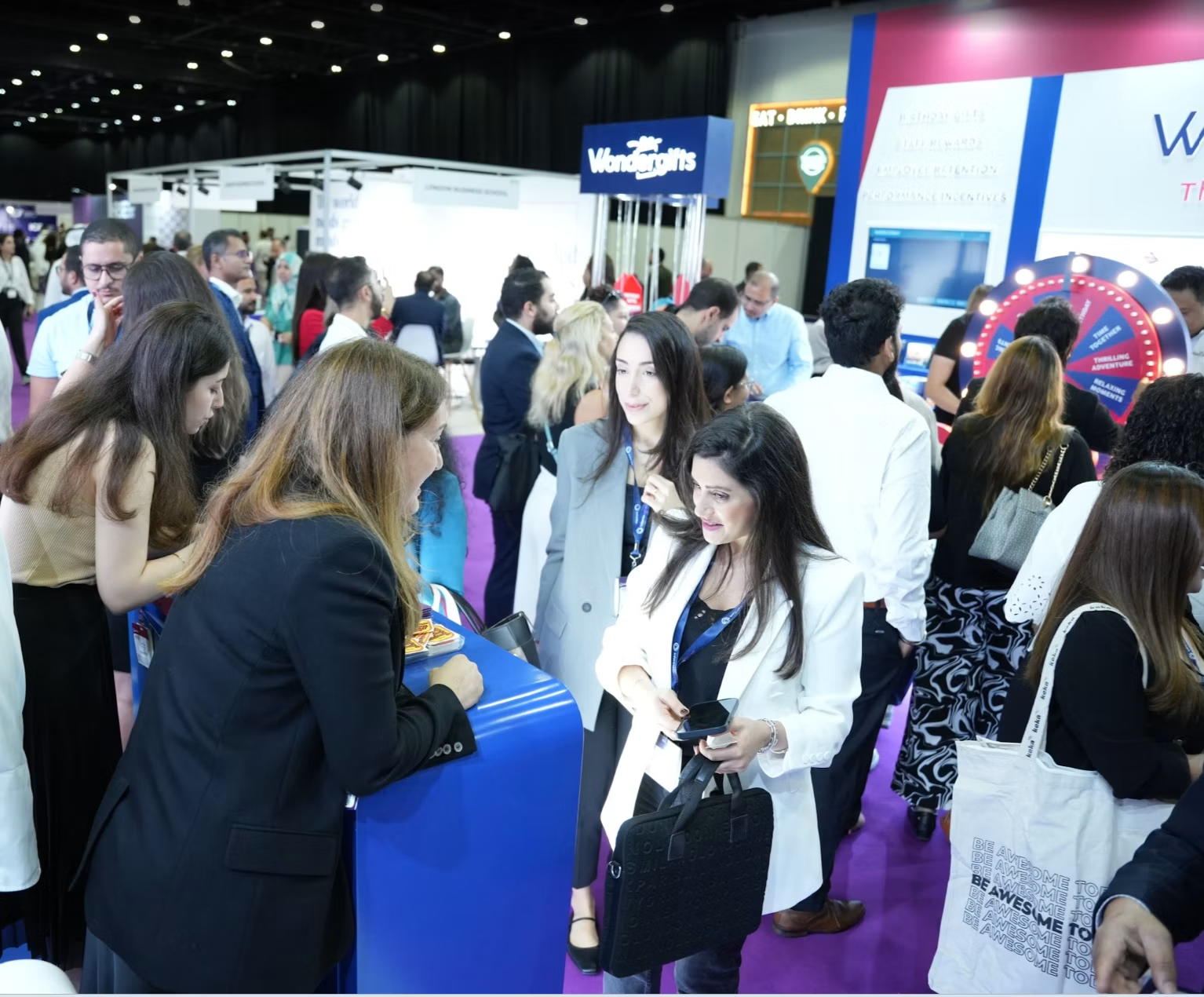
Human resources leaders, talent specialists, learning professionals, HR technology companies and senior business executives will gather at Dubai World Trade Centre on 14 and 15 October 2026 when HRSE Dubai returns as one of the Middle East’s largest gatherings dedicated to the future of work.
The main event and exhibition takes place in Hall 6 at DWTC, following three days of certified workshops from 11 to 13 October at Conrad Dubai.
The 2026 platform is expected to bring together more than 5,500 HR professionals, 125-plus speakers, over 120 sessions and more than 70 exhibitors and sponsors.
Its programme will address some of the biggest questions now facing employers.
How should companies use artificial intelligence without losing human judgement?
Which skills will employees need as work changes?
How can organisations recruit in increasingly competitive labour markets?
How should performance be measured in hybrid workplaces?
What does good leadership look like during constant technological change?
And how can HR demonstrate measurable business impact rather than being treated primarily as an administrative function?
For employers and HR professionals operating in Dubai and across the Middle East, HRSE 2026 provides two days to examine how these questions are changing organisations in real time.
HR Is Becoming More Strategic
Human resources was traditionally associated heavily with payroll, contracts, recruitment administration and employee records.
Those responsibilities still matter.
The profession is becoming much broader.
Companies now expect HR leaders to understand workforce planning.
Organisational design.
Leadership development.
Employee experience.
Analytics.
Technology.
AI.
Skills.
Culture.
Change management.
The strongest HR functions increasingly operate close to business strategy because people decisions affect whether companies can execute their plans at all.
A business can have excellent products and sufficient capital but still struggle if it cannot recruit or retain the people required to grow.
AI Is Changing Almost Every HR Process
Artificial intelligence is one of the dominant themes of HRSE Dubai 2026.
Recruitment systems can help screen large applicant pools.
AI can draft job descriptions.
Chatbots answer employee questions.
Learning platforms recommend training.
People analytics can identify workforce patterns.
Generative AI can support managers with routine communication.
These tools can improve productivity.
They also create new risks.
A recruitment model trained on biased historical data may reproduce that bias.
An AI-generated performance summary may contain inaccuracies.
Employees may enter confidential information into external systems.
Companies therefore need governance alongside adoption.
Recruitment Is Becoming More Data-Driven
Hiring has always involved judgement.
Technology now adds much more information.
Applicant tracking systems organise candidates.
Assessment platforms measure skills.
Interview tools help coordinate recruitment.
Labour-market data shows salary trends.
Analytics can identify which sourcing channels produce the strongest hires.
Used appropriately, this helps companies make better decisions.
Used poorly, it can create an impersonal recruitment process in which applicants feel they are interacting only with machines.
Employers still need to remember that strong candidates are evaluating the company at the same time the company is evaluating them.
Candidate Experience Can Affect Employer Reputation
A recruitment process may be someone’s first interaction with an organisation.
Long delays create frustration.
Unclear communication creates uncertainty.
Repeated interviews consume time.
Automated rejection without useful information can feel impersonal.
Companies competing for scarce skills cannot afford unnecessarily poor candidate experiences.
Good recruitment technology should reduce friction rather than add new layers.
Speed, transparency and respectful communication remain valuable regardless of how advanced AI becomes.
Skills Are Becoming More Important Than Job Titles
Technology changes jobs faster than traditional organisational structures can sometimes adapt.
A person may hold the same title while the skills required for the role change substantially.
Companies are therefore becoming more interested in skills-based workforce planning.
What can employees actually do?
Which capabilities are missing?
Which skills could be developed internally?
Where should the organisation recruit externally?
This approach can help companies use existing talent more effectively instead of automatically hiring whenever a new capability is required.
Reskilling Is Becoming a Business Requirement
AI and automation will change certain tasks.
That does not mean every affected employee becomes unnecessary.
Roles can evolve.
Employees can learn new tools.
Administrative work may decline while analytical or customer-facing responsibilities increase.
The challenge is providing meaningful reskilling before roles disappear.
Training programmes work best when connected with genuine future job opportunities.
Employees are unlikely to remain engaged with generic learning libraries that have little connection with career progression.
Learning and Development Needs Measurable Outcomes
Companies spend substantial amounts on training.
Attendance alone does not prove value.
Did the employee improve?
Did performance change?
Was the skill used at work?
Did the training help the company achieve an objective?
Modern learning and development increasingly requires stronger measurement.
Digital platforms make tracking easier.
But organisations need to define what success means before collecting data.
Completing ten online courses is not automatically an achievement if behaviour and results remain unchanged.
Leadership Is Changing Too
Managers increasingly lead teams across different locations, generations and working styles.
Some employees work in offices.
Others work remotely.
International teams collaborate across time zones.
AI changes how tasks are completed.
Managers therefore need capabilities beyond technical expertise.
Communication.
Trust.
Coaching.
Decision-making.
Conflict management.
Adaptability.
HRSE’s programme places leadership directly alongside technology because organisational transformation depends heavily on managers translating strategy into everyday behaviour.
Trust Has Become a Competitive Advantage
Companies can introduce monitoring technology easily.
Whether they should use every available capability is another question.
Excessive employee surveillance can damage trust.
Tracking keystrokes or constant activity may measure visible movement rather than actual productivity.
Knowledge work is particularly difficult to evaluate through simplistic metrics.
Organisations increasingly need to focus on outcomes.
What was delivered?
Was quality strong?
Were deadlines met?
Did the team collaborate effectively?
Trust does not mean having no accountability.
It means using appropriate measures.
Hybrid Work Is Still Evolving
The debate around remote work has not disappeared.
Some companies increased office requirements.
Others maintain flexible models.
Different industries require different approaches.
A hospital cannot operate like a software company.
A manufacturing employee cannot assemble products entirely from home.
Even within one organisation, some roles may require more physical presence than others.
The strongest policies are likely to be based on actual work requirements rather than ideological positions about where employees should sit.
The Office Needs a Purpose
If employees can complete focused individual work from home, commuting to an office simply to join video calls can feel pointless.
Companies increasingly need to define why people come together physically.
Collaboration.
Relationship building.
Creative work.
Training.
Mentoring.
Customer meetings.
The workplace becomes more valuable when designed around activities that benefit from shared presence.
This connects HR with facilities management and real estate strategy.
People Analytics Is Becoming More Sophisticated
Organisations possess substantial workforce data.
Turnover.
Absence.
Compensation.
Performance.
Skills.
Recruitment.
Engagement.
Learning.
Analytics can identify patterns.
Which teams have unusually high turnover?
Where are promotion rates unequal?
Which recruitment channels deliver employees who stay?
What skills will be needed in two years?
The objective should be better decisions rather than simply more dashboards.
Data becomes valuable when it leads to action.
Employee Privacy Still Matters
People analytics can become intrusive if governance is weak.
Employee data is sensitive.
Health information.
Performance information.
Compensation.
Personal details.
Behavioural data.
Access should be restricted.
Collection should have a clear purpose.
HR technology vendors also need appropriate security.
A company cannot claim to care about employees while handling their personal information carelessly.
Cybersecurity Is an HR Issue Too
Many security incidents begin with people.
Phishing.
Weak passwords.
Social engineering.
Misuse of access.
HR influences several parts of the security lifecycle.
New employees need appropriate access.
Departing employees need accounts disabled.
Training needs to be effective.
Sensitive personnel data requires protection.
HR and cybersecurity teams therefore need much closer cooperation than many organisations traditionally maintained.
Deepfakes Create New Workplace Risks
AI-generated voice and video make impersonation easier.
A finance employee could receive a realistic fake voice message appearing to come from a senior executive.
Recruitment teams may eventually encounter synthetic applicants.
Remote identity verification becomes more complicated.
Companies need processes that do not rely purely on whether something looks or sounds genuine.
Unusual financial or administrative requests should have independent verification steps.
Pay Transparency Is Expanding
Employees have greater access to salary information through online platforms and professional networks.
Some jurisdictions also require more transparency.
Companies therefore need clearer compensation structures.
Why does one employee earn more than another?
How are salary ranges created?
What determines promotion?
A compensation system does not need to pay everyone equally.
It should be explainable.
Perceived unfairness can damage engagement even when absolute pay is competitive.
Employee Experience Extends Across the Entire Journey
Employee experience begins before the first day.
Recruitment.
Onboarding.
Management.
Learning.
Pay.
Technology.
Work environment.
Career development.
Offboarding.
One excellent benefit cannot compensate indefinitely for poor management or unclear career opportunities.
HR increasingly needs to understand how these elements interact.
Experience is not simply free food or attractive offices.
It is how easy or difficult the organisation makes it for people to perform their jobs and develop.
Wellbeing Has Moved Beyond Corporate Perks
Employee wellbeing became a major business topic after the pandemic.
Organisations introduced wellness programmes.
The next stage requires more substance.
A meditation application cannot fix an unsustainable workload.
A wellbeing seminar cannot compensate for poor management.
Benefits can help.
Work design matters more.
Reasonable expectations.
Psychological safety.
Time to recover.
Fair treatment.
Good leadership.
HR needs to address structural causes rather than treating wellbeing only as a collection of optional programmes.
Burnout Can Become an Organisational Problem
Burnout is often discussed as if individuals simply need better coping skills.
Sometimes the underlying issue is organisational.
Constant understaffing.
Unclear priorities.
Excessive meetings.
Poor managers.
Impossible deadlines.
Employees cannot permanently compensate for dysfunctional systems through personal resilience.
People analytics and engagement data can help organisations identify where problems are concentrated.
Management then needs to respond.
Nationalisation Remains Important in Gulf Workforce Strategy
Gulf employers operate within national workforce-development policies including Emiratisation and similar initiatives across neighbouring countries.
Companies need sustainable approaches.
The objective should not be only meeting numerical requirements.
Employers benefit when local employees receive real career paths, meaningful work and leadership development.
Strong talent programmes build capability over time rather than treating nationalisation purely as compliance.
Younger Employees Expect Clear Development
Early-career professionals increasingly ask where a job can lead.
What will I learn?
How can I progress?
Which skills will I gain?
Career paths do not always need to be strictly vertical.
Employees can move laterally.
Take project roles.
Develop specialist expertise.
Participate in international assignments.
Organisations retain ambitious people more effectively when growth opportunities are visible.
Internal Mobility Can Reduce Recruitment Costs
Companies often recruit externally while qualified employees already exist elsewhere inside the organisation.
Internal talent marketplaces aim to address this.
Employees can identify projects or roles matching their skills.
Managers gain access to a broader internal talent pool.
This helps retain organisational knowledge.
Technology can support matching.
But managers also need incentives to allow good employees to move instead of trying to keep them indefinitely within one team.
Performance Management Is Becoming More Continuous
Annual performance reviews remain common.
Many organisations now add more frequent feedback.
This makes sense because waiting twelve months to discuss a problem is inefficient.
Regular conversations allow objectives to change.
Employees understand expectations.
Managers can coach earlier.
The danger is turning continuous feedback into continuous administration.
Good systems should create better conversations rather than endless forms.
HR Technology Is Becoming an Ecosystem
Large organisations may use multiple platforms.
Core HR.
Payroll.
Recruitment.
Learning.
Performance.
Engagement.
Benefits.
Analytics.
Workforce scheduling.
Integration becomes a major challenge.
Employees should not need ten systems to complete simple tasks.
HR technology purchasing therefore needs architecture thinking.
A brilliant isolated product can create more complexity if it does not connect properly with existing systems.
The HR Marketplace Features 70+ Providers
HRSE’s exhibition gives visitors access to more than 70 HR solution providers.
Technology demonstrations cover recruitment, learning, analytics, performance, engagement and workforce management.
For buyers, the advantage is comparison.
Sales presentations always show a product in its best light.
Decision-makers need to ask practical questions.
How long does implementation take?
Which systems integrate?
Where is data stored?
What support exists?
How is pricing calculated?
The best HR software is the one an organisation can actually implement successfully.
125+ Speakers Bring Different Perspectives
The 2026 programme lists more than 125 regional and international speakers across over 120 sessions.
Topics extend from AI and digital transformation to leadership, talent and performance.
The HR Leaders Conference adds a more focused environment for senior decision-makers.
Certified workshops provide practical learning before the main exhibition begins.
This combination makes HRSE part conference, part training platform and part technology marketplace.
The Future Workplace Awards Add Recognition
The Future Workplace Awards take place on 14 October.
Awards recognise organisations and leaders developing workplace practices across the region.
Recognition can help share successful approaches.
However, the most meaningful HR success happens after awards ceremonies.
Lower turnover.
Better leadership.
Stronger skills.
Fairer systems.
Improved business performance.
HR ultimately earns influence by producing measurable organisational outcomes.
Two Days Focused on the Human Side of Transformation
Technology is changing business quickly.
Companies can buy AI tools.
Automate processes.
Deploy new software.
Transformation still depends on people adopting those changes.
Employees need skills.
Managers need confidence.
Leaders need trust.
Culture influences whether strategies work.
That places HR at the centre of organisational transformation.
On 14 and 15 October 2026, HRSE Dubai will bring more than 5,500 HR professionals together at Dubai World Trade Centre to explore that changing role.
The future of work will certainly involve more artificial intelligence.
It will also require better human judgement about where that intelligence belongs.