


Skechers UAE National Day Run 2026 Brings Four Race Distances to Dubai on December 2
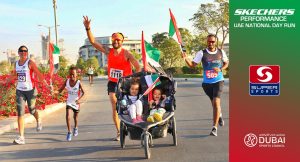
Dubai’s running community will mark UAE National Day in a distinctly active way on 2 December 2026 when the Skechers UAE National Day Run returns with four distances ranging from 3km to a full half marathon.
Participants can choose 21.1km, 10km, 5km or 3km, giving the event a structure that works for everyone from experienced endurance runners to families and beginners.
The race is organised by Super Sports UAE and combines competitive road running with a celebratory atmosphere linked to one of the most important dates on the UAE calendar.
For some runners, the objective will be a personal best.
For others, it will simply be completing a first organised race.
Families can participate over shorter distances.
Experienced athletes can take on the half marathon.
The mix makes the National Day Run much more than one race.
It becomes a community event built around several different levels of participation.
Why National Day Creates a Different Atmosphere
Most running events are defined primarily by distance.
National Day adds another dimension.
December 2 marks the anniversary of the formation of the United Arab Emirates, and celebrations across the country focus on national identity, unity and community.
A running event held on the same date naturally becomes part of that wider atmosphere.
Participants may wear UAE colours.
Flags appear around the event.
Families attend together.
The race becomes both a sporting challenge and a shared celebration.
That can make the experience feel very different from a normal weekend road race.
The Half Marathon Is the Biggest Challenge
The 21.1km category provides the main endurance test.
A half marathon requires several weeks of structured preparation for most recreational runners.
The distance is long enough that pacing, hydration and training quality all become important.
A runner cannot rely only on enthusiasm.
The first few kilometres may feel comfortable.
The later stages reveal whether preparation was effective.
That is why athletes targeting the half marathon should gradually build long runs during the weeks beforehand.
There is no need to complete 21km repeatedly in training.
But the body needs enough exposure to longer distances that race day does not feel completely unfamiliar.
Ten Kilometres Offers a Classic Road-Racing Test
The 10km distance is ideal for runners who want something shorter than a half marathon but more demanding than a basic fun run.
Ten kilometres can be approached in many ways.
A beginner may aim simply to finish continuously.
An intermediate runner may target a particular time.
An experienced athlete may race close to maximum sustainable intensity.
This flexibility makes the distance one of the most popular options at large running events.
It also provides a useful stepping stone for people considering longer races later in the season.
Five Kilometres Can Be Beginner-Friendly or Brutally Fast
The 5km category creates another accessible entry point.
For new runners, five kilometres can represent a major milestone.
Training is manageable.
Progress appears quickly.
A person can begin with walking and jogging intervals before gradually increasing continuous running time.
For experienced athletes, however, a 5K is far from easy.
The short distance allows runners to maintain a much higher intensity than during a half marathon.
There is little room to recover from a slow kilometre.
A well-run 5K can be one of the most uncomfortable events in endurance sport.
That is the beauty of the distance.
The same course works for complete beginners and serious competitors.
Three Kilometres Opens the Event to More Families
The 3km category makes the National Day Run especially accessible.
Children can participate.
Families can move together.
People who are not regular runners can still become part of the event.
This matters because large community races should not require everyone to arrive already fit.
Shorter distances create the first step.
Someone who walks or jogs 3km in December may decide to train for 5km next.
Progress becomes possible because the starting point was realistic.
The Course Is Designed for Fast Running
The National Day Run has traditionally used the Meydan and Nad Al Sheba area, with flat and relatively fast roads well suited to road racing.
A flatter course creates opportunities for personal-best attempts.
Runners can settle into rhythm without repeatedly adjusting effort for major climbs.
That does not mean the race becomes easy.
Flat courses often tempt athletes to run aggressively from the start.
The absence of hills removes natural recovery sections.
A runner who chooses the wrong pace may simply suffer continuously later.
Good pacing remains essential.
The Dubai Skyline Adds to the Experience
Urban running becomes more memorable when the surroundings feel connected to the city.
Routes around Meydan and Nad Al Sheba offer views toward Dubai’s skyline while runners move through quieter roads and landscaped areas.
For residents, those sights are familiar but look different from the middle of a race course.
For visitors, the setting creates a distinctly Dubai experience.
Destination races succeed partly because participants remember more than their finishing time.
They remember where they were.
National Day Colours Can Turn the Start Line Into a Celebration
Previous editions have encouraged runners to incorporate UAE flags and national colours into their race-day outfits.
That visual element changes the atmosphere immediately.
Instead of a start line filled only with technical sports clothing, the event becomes part race and part national celebration.
Participants should still make sensible equipment choices.
Anything worn during a half marathon needs to be comfortable.
Decorations should not interfere with running.
But simple national colours, caps or small flags can contribute to the shared spirit of the day.
December Is Excellent for Dubai Running
The timing is another major advantage.
December mornings generally provide some of Dubai’s best outdoor running conditions.
Temperatures are significantly more comfortable than during summer.
This allows athletes to race harder without dealing with the same level of heat stress.
The cooler season is one reason Dubai’s endurance calendar becomes particularly busy between November and February.
National Day arrives right in the middle of that period.
Half-Marathon Runners Need a Fuel Plan
The longest-distance participants should think about nutrition as well as training.
Some runners can complete a half marathon without consuming significant fuel.
Others perform better with carbohydrate during the race.
There is no universal strategy.
The important rule is testing.
Do not try a completely unfamiliar gel or drink on December 2.
Use long training runs to determine what works.
The stomach needs practice just like the legs.
Hydration Still Matters in Cooler Weather
Cooler weather can make runners underestimate fluid needs.
Sweating still occurs.
Athletes should arrive hydrated and use available refreshments based on personal requirements.
Drinking excessive amounts is not helpful either.
The goal is balance.
Experienced runners develop a hydration routine during training rather than reacting randomly on race day.
The Race Village Adds to the Community Feel
Participants receive standard race amenities including official timing, medals, certificates, race shirts and refreshments.
The wider race-village atmosphere adds music and social activity.
These details matter because many participants attend with friends or family.
The morning becomes more than the time spent running.
People gather before the race.
They celebrate afterwards.
Photos are taken.
Medals become souvenirs.
Community events succeed when participants want to remain after crossing the finish line rather than immediately leaving.
A Half Marathon Can Become a Winter Training Goal
For runners already training through autumn, the December 2 half marathon provides an excellent target.
The date creates enough time after summer to rebuild outdoor mileage.
It also arrives before Dubai Marathon and other major January races.
Athletes preparing for longer winter goals can use the National Day Run as an important test.
Twenty-one kilometres reveals a lot.
Is the current pace sustainable?
Is nutrition working?
Are shoes comfortable over longer distances?
Does training need adjustment?
A December race can provide useful information before January.
Families Can Celebrate Through Movement
National holidays are often associated with gatherings, entertainment and public celebrations.
Adding sport creates another tradition.
A family does not need to spend the entire day watching events.
They can begin with a run.
Children can participate in shorter categories.
Parents can choose a longer race.
The experience connects celebration with physical activity.
That has long-term value.
Children who see exercise as part of normal family life are more likely to consider activity something enjoyable rather than an obligation.
Four Distances, One Shared Event
The most attractive feature of the Skechers UAE National Day Run is that nobody needs to choose the same challenge.
One athlete can race 21.1km.
A friend can run 10km.
Another participant can attempt 5km.
A family can choose 3km.
They all still share the same wider event and the same National Day atmosphere.
That is what strong community sport looks like.
Different abilities.
Different goals.
One start-area celebration.
On 2 December 2026, Dubai runners will have another opportunity to combine endurance sport with one of the UAE’s most meaningful national occasions.
For some, the day will produce a fast time.
For others, a first medal.
Either way, it offers a memorable way to celebrate through movement.