


Ice Warrior Challenge 2026 Brings 20+ Frozen Obstacles Back to Ski Dubai
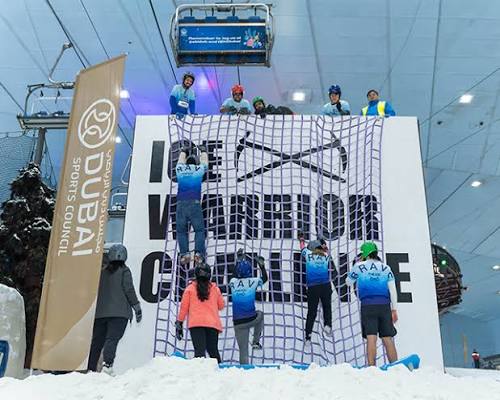
Dubai is known for desert endurance races, waterfront running events and outdoor fitness challenges, but one of the city’s most unusual competitions takes place in an environment that feels completely disconnected from the UAE climate.
The Ice Warrior Challenge returns to Ski Dubai on Sunday, 20 September 2026, bringing more than 20 obstacles into the indoor snow park at Mall of the Emirates.
Organised by Ski Dubai in collaboration with Dubai Sports Council, the event asks competitors to crawl, climb, jump, balance and push through an obstacle course in sub-zero conditions.
The 2026 edition is the 17th Ice Warrior Challenge, demonstrating how an initially unusual idea has developed into one of Dubai’s most distinctive annual fitness events.
Participants can enter Elite, Individual or Team of Five categories, creating options for competitive athletes as well as recreational fitness enthusiasts looking for a completely different weekend challenge.
Dubai’s Most Unusual Fitness Environment
The environment is what immediately separates Ice Warrior from conventional obstacle racing.
Outside Ski Dubai, September temperatures can remain extremely high.
Inside, competitors enter a snow-covered indoor environment maintained below freezing.
That temperature change affects the body immediately.
Muscles can feel tighter.
Hands become colder.
Grip can become more difficult.
Breathing cold air during intense exercise feels different from training in a normal gym.
Athletes therefore face two challenges at the same time.
They must complete the obstacles while also adapting to the environment.
This makes the event difficult to reproduce during ordinary training.
More Than 20 Obstacles Test the Whole Body
The 2026 course features more than 20 high-intensity obstacles.
Confirmed challenges include rope walls, monkey bars, tyre runs, net crawls and ice pools alongside new additions.
Each obstacle demands something different.
Climbing requires upper-body pulling strength.
Monkey bars test grip.
Tyre runs require coordination and fast footwork.
Crawling challenges mobility and core control.
Repeated obstacles elevate heart rate while the cold environment makes movement increasingly demanding.
The most successful competitors are therefore unlikely to be specialists in only one area.
A powerful weightlifter may struggle with endurance.
A strong runner may discover that grip strength becomes the limiting factor.
Ice Warrior rewards balanced fitness.
Grip Strength Could Decide the Course
Obstacle racing frequently exposes weak grip strength, and cold conditions can make the problem worse.
Participants need their hands for climbing, hanging and pulling.
Once the forearms become exhausted, obstacles that looked simple at the beginning of the event become significantly more difficult.
Basic exercises can help during preparation.
Dead hangs from a pull-up bar build grip endurance.
Farmer carries strengthen the hands and forearms while also training the core.
Pull-ups and assisted pull-ups improve pulling strength.
Towel hangs can make gripping even more demanding.
The goal is not simply to become stronger.
Participants need to remain capable of gripping after running and completing several previous obstacles.
The Elite Category Raises the Standard
The Elite category is intended for highly fit athletes who can complete the course in under 25 minutes.
That time expectation changes the nature of the competition.
Elite participants cannot approach each obstacle slowly.
Transitions need to be efficient.
Running sections need to be fast.
Mistakes become expensive.
An athlete may have the strength to complete every obstacle but still lose significant time through hesitation or inefficient technique.
Elite obstacle racing therefore combines fitness with familiarity.
Competitors who understand how to approach walls, bars and crawling sections can often move far more efficiently than stronger athletes with less experience.
The Individual Category Keeps the Event Accessible
Not everyone wants to race against elite-level competitors.
The Individual category is open to a broader range of fitness levels.
This makes Ice Warrior suitable for recreational athletes looking for a memorable challenge rather than a podium position.
Completing the course can be the goal.
Participants still need reasonable fitness.
More than 20 obstacles in the cold are not easy.
But there is no requirement to perform at elite speed.
That distinction is important.
Community sporting events grow when ordinary participants have a realistic way to take part.
Teams of Five Add a Social Element
The Team of Five category allows friends, relatives or colleagues to take on the challenge together.
Obstacle events work particularly well as group activities because different people bring different strengths.
One teammate may be a strong climber.
Another may have better endurance.
Someone else may remain calm around obstacles others find intimidating.
Teams can encourage one another through difficult sections.
That social support matters.
A challenge that feels unpleasant alone can become entertaining when completed with friends.
This is one reason obstacle racing has become popular for corporate groups and fitness communities.
Cold Changes the Warm-Up
Competitors should not treat the warm-up casually.
The colder environment means the body benefits from arriving physically prepared before attacking explosive movements.
A sensible warm-up should gradually increase heart rate.
Dynamic movements can prepare the hips, shoulders and ankles.
Light jogging can increase circulation.
Participants should avoid exhausting themselves before the course begins.
The objective is to become warm and mobile, not tired.
Standing still for a long period after warming up should also be avoided where possible.
Clothing Requires a Different Strategy
Normal Dubai race clothing is designed to manage heat.
Ice Warrior requires the opposite.
Participants need enough protection from the cold while still remaining mobile.
Extremely heavy clothing can become restrictive.
Anything that absorbs water from an ice obstacle may become uncomfortable.
The ideal clothing needs to provide warmth without preventing crawling, climbing and jumping.
Gloves may also influence grip.
Participants should follow organiser guidance closely and avoid experimenting with unsuitable equipment on event morning.
Obstacle Technique Can Save More Energy Than Strength
One of the biggest misconceptions around obstacle racing is that every challenge should be attacked with maximum force.
Good technique often saves far more energy.
Climbing efficiently reduces unnecessary pulling.
Keeping the body close to a structure can improve control.
Using leg drive can reduce the workload on the arms.
Maintaining rhythm across monkey bars can be easier than pausing between every movement.
These small efficiencies matter because the athlete still has many obstacles ahead.
Spending everything on the first difficult challenge is rarely a smart strategy.
Ice Pools Add a Psychological Test
Cold-water obstacles can create hesitation before the athlete even enters.
This psychological reaction is normal.
Cold water produces an immediate physical response.
Breathing may become faster.
The body naturally wants to escape the discomfort.
Staying calm helps.
The goal is to complete the required section efficiently and continue moving.
Participants with relevant medical concerns should follow event safety guidance carefully rather than treating cold exposure as something to simply push through.
Obstacle Racing Rewards Adaptability
Unlike a normal 5K or 10K race, competitors cannot settle into one movement pattern.
The body constantly changes tasks.
Run.
Climb.
Crawl.
Hang.
Balance.
Move again.
That variability is one reason obstacle events can be so exhausting.
The cardiovascular system remains active while different muscle groups repeatedly become involved.
Training should reflect this.
Combination workouts can be more useful than preparing each ability completely separately.
A participant might run for several minutes, perform bodyweight exercises, carry weights and then return to running.
The exact obstacles do not need to be recreated.
The objective is learning to change tasks while fatigued.
Seventeen Editions Have Created a Dubai Tradition
The Ice Warrior Challenge is now in its 17th edition.
That longevity is impressive for such an unusual concept.
Dubai constantly introduces new sporting events, but relatively few continue long enough to develop genuine tradition.
Ice Warrior has found a clear identity.
It takes the obstacle-racing concept and places it somewhere completely unexpected.
That uniqueness gives participants a reason to return.
An outdoor obstacle race can be staged almost anywhere.
A frozen obstacle race inside Dubai is something different.
The Event Demonstrates Dubai’s Sporting Variety
The timing also highlights the diversity of Dubai’s sports calendar.
Only days later, international basketball begins at Coca-Cola Arena.
Running events accelerate as temperatures improve.
Fitness exhibitions arrive.
Triathlons, cycling events and golf tournaments follow.
Dubai does not build its sporting identity around one discipline.
Ice Warrior contributes precisely because it is so different.
A Challenge Where the Environment Is Part of the Course
When participants arrive at Ski Dubai on 20 September, the obstacles will only be part of the test.
The cold will matter.
The snow will matter.
Wet equipment will matter.
Grip will matter.
The ability to adapt will matter.
Some competitors will chase the fastest possible time.
Others will be satisfied simply to reach the finish.
Teams will help one another.
First-time participants will discover weaknesses they never noticed during normal gym training.
That unpredictability is exactly why the Ice Warrior Challenge has survived for 17 editions.
Dubai already knows how to create difficult sporting events in the desert.
This one proves it can create a serious endurance challenge in the snow too.