


Emirates Dubai Sail Grand Prix 2026 Brings High-Speed F50 Racing Back to Mina Rashid
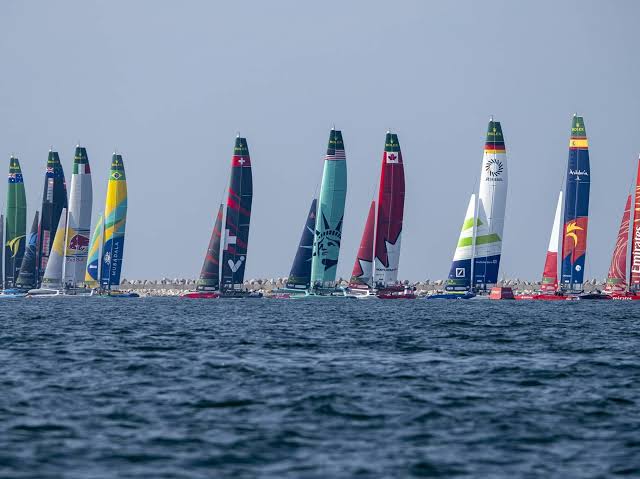
Dubai’s waterfront will become one of the fastest sailing venues in the world on 21 and 22 November 2026 when the Emirates Dubai Sail Grand Prix presented by DP World returns to Mina Rashid.
The event forms the penultimate round of the 2026 Rolex SailGP Championship and brings 13 national teams together in identical F50 foiling catamarans capable of approaching 100km/h.
For spectators unfamiliar with SailGP, the speed can be difficult to imagine.
These are not traditional yachts moving slowly across the water.
The F50s rise above the surface on hydrofoils, dramatically reducing drag and allowing them to accelerate to extraordinary speeds.
The result is sailing that often looks closer to motorsport than a conventional regatta.
Why SailGP Feels So Different
Traditional sailing can sometimes be difficult for casual spectators to understand.
Races may cover large areas.
Boats can appear distant.
Tactical decisions are not always obvious.
SailGP was designed to change that experience.
Racing takes place close to shore.
The courses are compact.
Multiple races can be completed during a single session.
Spectators can watch teams accelerate, cross, turn and fight for position within sight of the race stadium.
This creates much more immediate action.
One poor manoeuvre can cost several places.
One strong start can completely change a race.
The short format makes every decision important.
The F50 Is an Extraordinary Machine
At the centre of SailGP is the F50.
The boat uses hydrofoils to lift the hull above the water when enough speed is generated.
Once airborne, resistance falls dramatically.
That allows the boat to travel faster than the wind itself under the right conditions.
Watching an F50 at full speed is unusual because so little of the boat appears to touch the water.
The hull flies above the surface while the foils provide lift and control.
This demands extraordinary precision from the crew.
Small adjustments can influence stability.
At high speeds, mistakes happen quickly.
The sailors need to process information continuously while the boat travels at speeds most people associate with road vehicles.
Thirteen Nations Make Every Race Competitive
The Dubai event is expected to feature 13 national teams battling for crucial championship points.
Because every team races essentially identical equipment, the competition places enormous emphasis on athlete performance.
There is less opportunity to blame a fundamentally faster boat.
The difference comes from sailing technique, communication, strategy and execution.
This creates close racing.
Teams can gain or lose positions within seconds.
The championship format also means that Dubai arrives at an important point in the season.
Only one event remains afterwards.
Every point therefore carries greater value.
A strong weekend in Dubai can completely change championship momentum.
A poor result may leave a team with little opportunity to recover.
The Start Can Decide Everything
One of the most exciting parts of a SailGP race occurs before the official start.
Teams approach the line while trying to position themselves perfectly for the countdown.
Cross too early and penalties follow.
Arrive too late and faster competitors can immediately gain clean water and space.
The objective is to hit the starting line at speed at exactly the right moment.
That requires timing and tactical awareness.
Boats are manoeuvring around each other while travelling quickly.
Crews are watching opponents, wind conditions and the clock simultaneously.
A strong start does not guarantee victory, but a poor one makes the rest of the race significantly harder.
Wind Is the Invisible Playing Field
Sailing is unusual because the playing surface is constantly changing.
The water is visible.
The wind is not.
Yet wind direction and strength determine almost everything.
Teams need to recognise where stronger wind may exist across the course.
A small difference can create a large speed advantage.
Experienced sailors read visual clues from the water and use data supplied by sophisticated onboard systems.
The tactical battle is therefore not simply boat against boat.
It is also about understanding the environment faster than the opposition.
Turning at Speed Requires Precision
F50s do not simply accelerate in straight lines.
Teams must repeatedly turn around course markers.
These manoeuvres can be decisive.
A badly executed turn causes the boat to lose speed.
The foils may drop back into the water.
A rival can immediately pass.
A clean manoeuvre keeps the boat flying and preserves momentum.
Crew coordination is essential.
Everyone needs to know exactly what happens next.
At this level, hesitation costs distance.
Communication Happens Under Extreme Pressure
A SailGP team consists of specialised athletes performing different roles.
Communication needs to be short and clear.
There is no time for long discussion.
The boat is travelling too fast.
Conditions change too quickly.
This is one reason professional sailing is as much about teamwork as individual skill.
A brilliant athlete cannot compensate for poor communication across the entire boat.
The crew needs to function as one system.
Mina Rashid Creates a Strong Spectator Venue
Dubai’s Mina Rashid waterfront provides an ideal setting for this style of racing.
The course keeps competition close enough for spectators to follow the action.
Dubai’s skyline and port environment also create a distinctive backdrop.
For visiting fans, this makes the event visually connected to the city.
For residents, it offers an opportunity to experience the waterfront in a completely different way.
Instead of simply watching boats in the distance, spectators see one of the world’s fastest sailing competitions.
The Race Stadium Adds More Than Sailing
The Dubai Sail Grand Prix is designed as a full spectator event rather than simply a sporting competition.
The Race Stadium includes entertainment, interactive experiences and live performances around the racing.
This makes the weekend more accessible to families and people who may not already follow professional sailing.
A newcomer does not need to understand every technical detail before attending.
The speed and close racing are immediately understandable.
The tactical details can come later.
Why Dubai Fits SailGP
Dubai has built much of its sporting reputation around international events that combine elite competition with destination appeal.
SailGP fits that strategy extremely well.
The event is visually striking.
It uses the city’s waterfront.
International teams bring global audiences.
The compact racing format works well for television and live spectators.
Dubai also sits naturally within a championship that travels between major global cities.
The setting becomes part of the sporting identity.
Sailing Athletes Need Exceptional Fitness
Sailing may not always look physically demanding from shore.
F50 racing changes that assumption quickly.
Athletes need strength, balance and cardiovascular fitness.
The boat generates significant forces.
Crew members move rapidly during manoeuvres.
Some roles involve repeated high-intensity physical effort.
Decision-making also needs to remain sharp despite fatigue.
That combination makes SailGP athletes very different from the stereotypical image of relaxed recreational sailors.
Technology Is Everywhere
SailGP is also a technology competition.
Boats generate enormous amounts of data.
Teams analyse performance.
Sensors provide information about speed, foil position and other variables.
Athletes combine instinct with real-time information.
This technology helps explain how sailing has become so precise.
Small improvements can be identified scientifically.
The boats may all begin with similar equipment, but teams still search constantly for performance advantages through technique and analysis.
The Penultimate Round Raises the Stakes
Dubai’s position as the second-last event of the 2026 championship makes the weekend especially important.
At the beginning of a season, teams have time to recover from mistakes.
By November, that margin has disappeared.
Championship leaders want to protect their advantage.
Chasing teams need aggressive results.
Midfield teams may still be fighting for position and prize money.
Every race contributes to the final picture.
This can influence strategy.
Some teams may take more risks because conservative results are no longer enough.
A Great Introduction to Professional Sailing
For people who have never attended a sailing event, SailGP may be the ideal starting point.
The races are short.
The boats are fast.
The course is compact.
National teams give spectators an immediate connection.
Digital graphics and commentary help explain tactical situations.
You do not need years of sailing knowledge to understand a boat travelling at extreme speed toward a tight mark with rivals only metres away.
The excitement is obvious.
Dubai’s Waterfront Gets a Different Kind of Speed
Dubai already hosts motorsport, cycling, running and horse racing events built around speed.
SailGP adds another version.
There are no engines.
The energy comes from wind.
Yet the performance is extraordinary.
On 21 and 22 November, Mina Rashid will become a high-speed race course where 13 teams attempt to control one of the most advanced sailing machines in sport.
For established sailing fans, the weekend offers crucial championship racing.
For newcomers, it provides a simple lesson.
Sailing can be much faster, louder and more dramatic than they imagined.